
Natural Fruit Concentrates and Clean Label: A New Approach to Product Composition
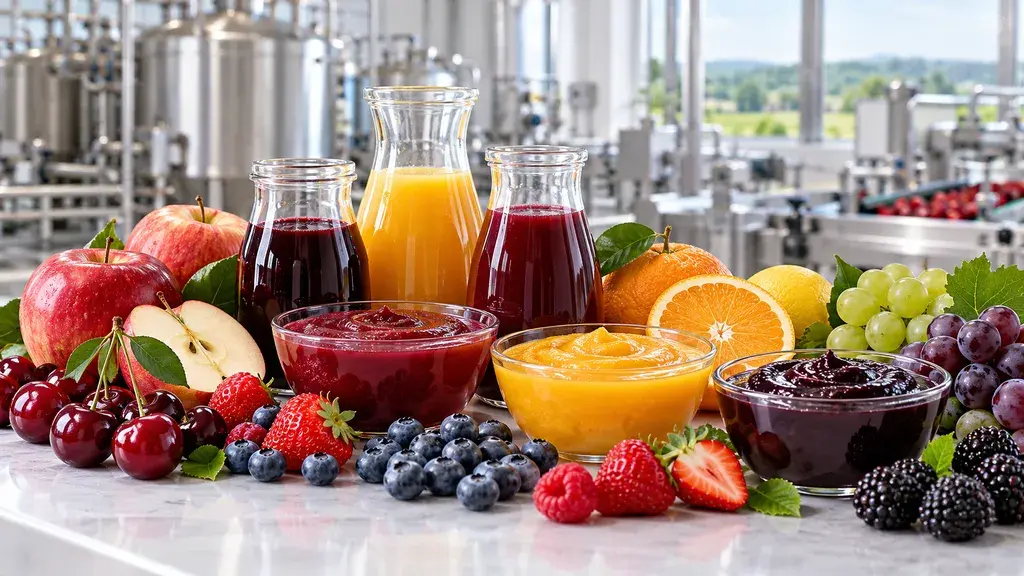
The modern food market is characterised by the fact that consumers read labels much more carefully than before and show greater interest in the origin of ingredients. That is why natural fruit ingredients are becoming an important part of product development, where the origin of raw materials matters no less than their technological properties.
Fruit ingredients for production make it possible to include the recognisable taste of fruits and berries in a formulation. At the same time, the word “natural” in itself does not guarantee that the product will meet consumer expectations. It is important to understand the method of raw material processing, its characteristics, and its role in the finished product. The Clean Label approach helps assess these issues comprehensively — from the choice of ingredients to the information provided on the packaging. In this article, we will look at what this format involves.
Why Clean Label has become an important benchmark for the food industry
There is no single definition of Clean Label that applies equally to all countries and product categories. Usually, this approach is understood as a commitment to clear labelling, transparent raw material origin, and the use of components whose purpose can be explained in a clear and understandable way. Some manufacturers reduce the number of ingredients, while others aim to avoid certain artificial additives or find suitable alternatives.
Natural food concentrates can support such an approach if they fit the formulation and their properties are accurately reflected in the documentation. The mere presence of a fruit component does not automatically make a product compliant with Clean Label principles: all ingredients, the technology used, and legal requirements are taken into account.
Therefore, it is important to evaluate specific data rather than relying only on marketing claims. For this reason, when choosing raw materials, ask the manufacturer of fruit-based food ingredients for information about origin, batch characteristics, storage conditions, and accompanying documentation.
How natural fruit concentrates are used in formulations
A concentrate is obtained by removing part of the water from fruit juice. In a formulation, it may serve as a fruit base, complement the flavour, or become part of a complex ingredient blend. The concentrated format is convenient for industrial logistics and dosing, but the working parameters depend on the type of raw material and the production technology.
Natural fruit concentrates from Uzbekistan can be a sourcing option for companies producing beverages and other food products. Before placing an order, it is important to clarify:
- the type of fruit, concentration indicators, and organoleptic characteristics;
- storage conditions, packaging, and shelf life;
- acceptable batch-to-batch variations and the incoming quality control procedure.
Concentrates for food production require testing under conditions close to the actual process. A sample is evaluated in terms of taste, colour, acidity, behaviour during heating, and interaction with other components. For example, lemon concentrate affects not only the aroma but also the acidity of the blend, while a berry base influences the colour and flavour balance.
In which product categories fruit ingredients are used
In beverages, a fruit base shapes the flavour and helps maintain the desired profile. Juice concentrates for beverage production are used in the manufacture of juices, nectars, fruit drinks, and blended beverages. Depending on the formulation, they are combined with water and other components while controlling sweetness, acidity, and aroma intensity.
In yoghurts, curd desserts, and other dairy products, the fruit component adds flavour and colour and sometimes contributes to texture formation. For such tasks, fruit masses and fillings are used, and their properties are assessed with regard to the acidity of the dairy base and storage conditions. In confectionery products, fruit filling, confiture, or a berry layer complement the creamy profile of desserts and baked goods, although the requirements for density and stability vary.
Fruit raw materials for the food industry are also in demand in combined products. Depending on the task, apple, grapefruit, blackberry, and other fruits and berries are used. The fresh, ripe taste of the original raw material should be preserved in the expected form after processing, but even a carefully selected fruit from the tree does not guarantee identical characteristics in every batch. That is why a specification and verification of actual characteristics are essential.
Natural fruit concentrates from Uzbekistan for B2B production
For a procurement specialist, the properties of the ingredient and the ability to plan production without interruptions are important. When choosing a supplier of concentrates in Uzbekistan, it is worth assessing not only the characteristics of the raw material but also the organisation of cooperation. The following conditions are important for a food enterprise:
- agreement on production volumes and expected shipment сроки;
- the ability to plan purchases in advance, taking into account the seasonality of raw materials;
- provision of information about product characteristics and accompanying documentation;
- discussion of the customer’s raw material requirements before supplies begin.
Concentrated Juice & Puree produces concentrated juices and purees; since 2019, the company has been supplying fruit concentrates for export. Production is planned to order: volumes and shipment recipients are agreed at the beginning of the season. The products are manufactured using high-tech equipment from Europe, Turkey, and China in accordance with applicable interstate standards.
Reliable cooperation is built on transparent characteristics, clear agreements, and stable communication. If you plan to buy concentrates in Uzbekistan, prepare information about the intended use of the ingredient, the required volume, the procurement schedule, and key technological parameters. This will help you discuss the supply format in a concrete way and evaluate whether the raw material matches your production needs.