
Uzbekistan’s Autumn Harvest as a Raw Material for the Food Industry: The Potential of Fruit Concentrates
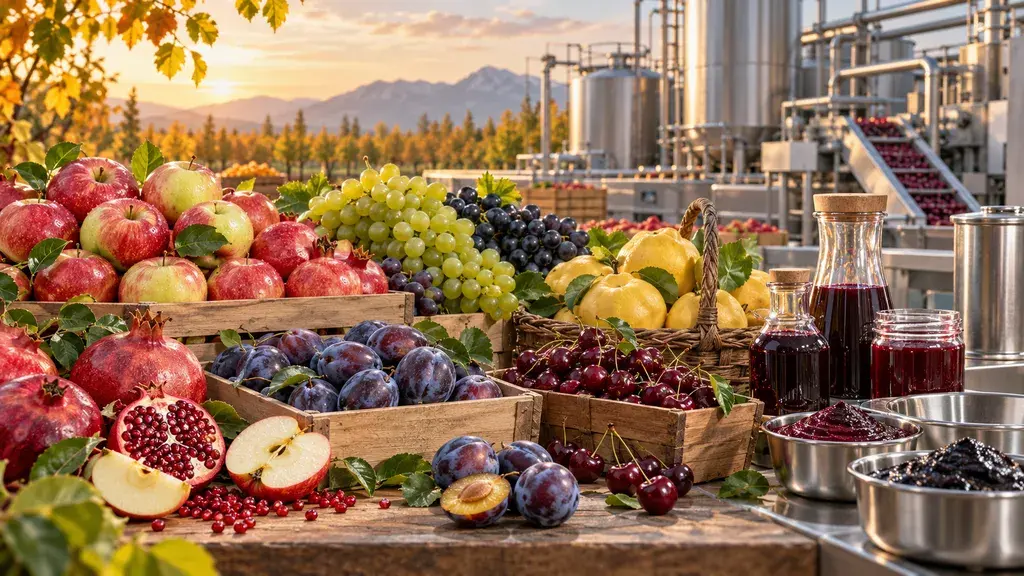
Autumn is an important period for the fruit processing industry. During this season, the harvesting of late apple varieties and other fruits continues, while processing companies receive significant volumes of fresh raw materials for further processing. For the food industry, the value of the harvest lies not only in selling fresh fruit: processing makes it possible to turn seasonal raw materials into concentrates, juices, purees, and other ingredients that can be used in production for a longer period.
Uzbekistan has a substantial fruit and vegetable raw material base. According to preliminary data from the National Statistics Committee, approximately 3.48 million tonnes of fruits and berries were produced in the country in 2025, which was 6.4% more than in the previous year. Among the regions with the largest production volumes of fruits and berries were Andijan, Fergana, Namangan, and Samarkand regions.
Such a raw material base creates opportunities not only for the fresh produce market but also for the further development of processing. Fruit concentrates are one of the ways to preserve the value of the harvest and transform seasonal fruits into industrial ingredients demanded by beverage and food manufacturers.
Which fruits form Uzbekistan’s raw material base
Fruit growing in Uzbekistan is characterised by considerable diversity. National statistics separately track the production of apples, pears, quinces, cherries, and other fruit crops. In 2024, for example, apple production across all categories of farms reached approximately 1.5 million tonnes, compared with 1.03 million tonnes in 2017. Fruits with a pronounced flavour profile and the potential to be used as a base for juice and food products are particularly interesting for processing:
- apples;
- cherries and other stone fruits;
- pomegranates;
- quinces;
- plums;
- grapes;
- other locally grown fruits and berries.
Some late apple varieties ripen directly at the beginning of the autumn season. For example, the Ministry of Agriculture of Uzbekistan states that the Vainsen variety reaches maturity in the third ten-day period of September. Sweet cherries also have particular importance for the country: Uzbekistan produces up to 180,000 tonnes of this crop annually, while FAO considers it one of the products with strong potential for the development of the entire value chain — from cultivation and post-harvest handling to processing and access to international markets. At the same time, the total volume of the harvest is not the only factor that matters to a processor. The variety, degree of ripeness, flavour profile, soluble solids content, and intended use of the future product are also important.
Why seasonal fruits are processed into concentrate
Fresh fruits have a limited storage period and depend on seasonality. Industrial processing helps transform them into raw materials that are more convenient for further manufacturing. According to the Codex Alimentarius definition, concentrated fruit juice is obtained by physically removing part of the water from fruit juice, resulting in a soluble solids content significantly higher than that of reconstituted juice from the same type of fruit. This is why concentrate differs from regular juice primarily in the degree of concentration.
For a food manufacturing company, this format provides several practical advantages:
- less volume is required for transportation compared with the original juice;
- the raw material is more convenient for use in different types of products;
- production can be planned beyond the fruit harvesting season;
- the concentrate can be used as an independent fruit base or as part of a complex formulation;
- companies can work with industrial-scale batches of raw material.
It is also important that Codex standards provide for the use of appropriate technological processes that help preserve the characteristic properties of the juice obtained from the relevant type of fruit.
Natural fruit concentrates in food production
Natural fruit concentrates are in demand across different segments of the food industry. Their final application depends on the type of fruit, the technological characteristics of the product, and the manufacturer’s formulation. Concentrates can be used in the production of:
- juices and nectars;
- fruit and blended beverages;
- fruit drinks;
- syrups;
- fruit fillings;
- dairy products;
- confectionery products;
- desserts;
- sauces and other food products.
For example, an apple base is versatile and works well in blended formulations. Cherry raw material is in demand where a pronounced sweet-and-sour berry profile is required, while pomegranate can be used in formulations with a more intense flavour character. At the same time, the concept of high-quality concentrates for an industrial buyer should not be reduced solely to the intensity of flavour. In practice, consistency of batch characteristics, suitability of the raw material for a specific formulation, storage conditions, packaging, and the manufacturer’s ability to supply the required volumes are all important.
From fresh harvest to an industrial ingredient
The processing chain begins even before the juice itself is obtained. The condition of the raw material matters for the future concentrate, which is why the technological process includes several consecutive stages. In general, it may include:
- receiving fruit raw materials;
- sorting and removing unsuitable fruits;
- washing and preparation;
- crushing or pressing;
- obtaining juice;
- processing according to the technology required for the particular product;
- removing part of the water and concentrating;
- preparing the concentrate for storage and supply.
The specific technology depends on the type of fruit and the requirements for the finished product. The process for puree differs. Codex defines fruit puree as a product obtained by processing the edible part of a whole or peeled fruit without removing the juice; concentrated puree is produced by physically removing part of the water from fruit puree. Therefore, concentrated juice and fruit puree are different categories of industrial raw materials and are intended for different applications in food production.
Why processing is important for Uzbekistan’s fruit and vegetable industry
The development of processing makes it possible to create additional value within the country rather than limiting the industry to the supply of fresh raw materials. The World Bank notes that the further development of Uzbekistan’s horticultural sector is connected, among other things, with strengthening production value chains, expanding agro-processing and logistics, and improving access to export markets. During the implementation of development programmes, more than 5,000 enterprises received opportunities to modernise and expand production.
Government policy is also focused on increasing the value of processed agricultural products. Approved measures for the development of the sector provide for expanding the export potential of fruit and vegetable and food products, as well as developing infrastructure and packaging. For concentrate manufacturers, this means broader opportunities in several areas:
- working with locally grown fruit raw materials;
- creating products with greater added value;
- supplying food companies within the country;
- developing B2B cooperation;
- entering international markets.
Fruit concentrates from Uzbekistan for export supplies
Interest in products from Uzbekistan is determined not only by the volume of fruit grown in the country. For an international B2B buyer, the entire chain matters — from the origin of the raw material to the manufacturer’s ability to consistently produce the required batches and organise deliveries. In 2025, Uzbekistan’s total exports increased to $33.4 billion, while food products were among the sectors showing noticeable export growth.
For companies planning to buy concentrates from Uzbekistan, it is advisable to clarify the following with a potential supplier in advance:
- the type of fruit raw material used;
- concentrate characteristics;
- intended application;
- available volumes;
- type of packaging;
- storage conditions;
- transportation requirements;
- accompanying documentation;
- possibilities for regular supplies.
This approach is particularly important for long-term cooperation, because industrial production requires predictable raw material characteristics from one batch to another.
Sale of concentrates in Uzbekistan: direct cooperation with the manufacturer
For food manufacturing companies, direct contact with the producer makes it possible to discuss not only price but also technological product requirements, intended use, batch volumes, and delivery schedules. The sale of concentrates in Uzbekistan is primarily focused on the professional market: juice and beverage manufacturers, food processing companies, distributors, importers, and other businesses that use fruit raw materials in further production.
Concentrated Juice & Puree works with fruit raw materials and produces concentrated juices and purees for the B2B segment. Its production capabilities make it possible to use the potential of Uzbekistan’s fruit-growing sector to create ingredients suitable for both the domestic market and export supplies.
From seasonal harvest to year-round production
The autumn harvest is not merely a period when large volumes of fresh fruit enter the market. For the food industry, it is part of a much longer production chain. Processing makes it possible to transform seasonal raw materials into fruit concentrates, concentrated juices, and purees that manufacturers can use throughout the production cycle. Uzbekistan’s developed raw material base, together with the continued modernisation of processing and logistics, creates opportunities for this sector to grow both domestically and in export markets.
For food manufacturers, this means an opportunity to source fruit raw materials directly from the country of origin and select them according to a specific formulation, production volume, and requirements for the finished product. To learn more about the range of fruit concentrates, product characteristics, available volumes, and B2B supply terms, you can contact the specialists at Concentrated Juice & Puree and discuss the requirements of your production.